jeudi 15 octobre 2015

about LONMIN @ The Fool


JUBILEE PLATINUM PLC (JLP)

3,95 GBp 
+2,60% | +0,10
 15/10/2015 17:29


LONMIN (LMI)

36,75 GBp 
+5,76% | +2,00
 15/10/2015 17:35


Should You Buy Lonmin Plc And Jubilee Platinum PLC As Metal Prices Surge?


By Royston Wild - Thursday, 15 October, 2015

The sudden rise in platinum prices since the start of October has been nothing short of phenomenal. From plunging to seven-year troughs of $908 per ounce late last month, the white metal has gained 10% in just over a fortnight and was recently sitting back above the $1,000 marker.
Investor sentiment for platinum has returned as further delays in Federal Reserve rate hikes have dented the value of the US dollar. Indeed, the Dollar Index -- a measure of the greenback versus a basket of currencies -- struck seven-week lows just this week. In addition, platinum has been caught in the gold price updraft, the yellow metal having advanced 7% during the past couple of weeks, too.
With buyers now charging back into the precious metals markets, could now be the time to pile back into embattled platinum group metal plays Lonmin (LSE: LMI) and Jubilee Platinum (LSE: JLP)?

Prices primed to pump higher?

Well, Bank of America-Merrill Lynch certainly feels that platinum could be in for strong price gains in the months and years ahead. The broker expects an average price of $1,065 per ounce for 2015 to advance to $1,100 next year, before marching to $1,250 in 2017 and $1,425 in 2018.
Bank of America believes that Chinese platinum demand has now stabilised, and fully expects physical off-take from the jewellery and autocatalyst segments to rebound strongly next year, pushing the market into deficit.
However, the broker acknowledges a range of factors that could keep platinum prices under the cosh. Adding to the risk of rising prices on jewellery demand, and lower sales to European buyers, Bank of America notes that "producers in South Africa need to show more production discipline," adding that "putting more ounces into the market at lower cost is not a recipe for success."
Lonmin responded to such calls in July by announcing it was reducing production by some 100,000 ounces each year by 2017, achieved through the closure of its Hossy and Newman shafts in South Africa. And Glencore announced just this month it was closing its Eland mine in the country.

Auto demand set to dive?

Although a welcome step in the right direction, I believe the platinum market remains a risky bet at the current time.
As Bank of America notes, demand from Europe remains a critical factor for metal prices looking ahead. And with the fallout of the Volkswagen emissions-rigging scandal threatening the future of the diesel engine -- 48% of platinum demand comes from autocatalyst builders -- sales to this key European-centric market could nose-dive in the years ahead.
On top of this, the likes of Lonmin also face the ongoing problem of breakneck cost inflation. Lonmin itself has taken the decision to concentrate on immediately available ore reserves for mining activities, but the issue of rising wages, power tariffs and general operational costs remain a millstone around the industry's neck. When you throw in the potential for fresh strike action -- a common problem in South Africa's mining sector -- costs are in danger of spiralling still higher.
Platinum prices have risen as quickly in recent weeks as they had previously fallen, reflecting the volatile nature of market sentiment at the current time. Should further disappointing data emerge from China in the near-term, I believe the metal -- and consequently shares in Lonmin and Jubilee Platinum -- could be sent hurtling lower once again.
But regardless of whether you share my cautious take on the platinum market, I strongly recommend you check out this totally exclusive report that identifies a wide array of big-cap winners waiting to kick-start your investment income.

Royston Wild has no position in any shares mentioned. The Motley Fool UK has no position in any of the shares mentioned. We Fools don't all hold the same opinions, but we all believe that considering a diverse range of insights makes us better investors.


EURO trend by Sara @ MarketWatch

Why more ECB QE won’t kill this euro rally


Published: Oct 15, 2015 3:10 a.m. ET


Sara Sjolin is a MarketWatch reporter based in London. Follow her on Twitter @sarasjolin.

All the stars are aligning for a weaker euro: Deflation is knocking on the eurozone’s door, there’s been a string of lackluster economic data and the European Central Bank is increasingly expected to launch more QE.
Yet, the shared currency is having none of it. Over the last three months, the euroEURUSD, -0.3573% has risen nearly 5% against the dollar to trade around $1.1441 and tacked on 5.8% against the pound EURGBP, -0.3776% to £0.7425.
This comes even as several analysts earlier in the year proclaimed 2015 would be the year when the euro slumped to parity with the dollar for the first time since 2002, following an aggressive round of ECB easing and expectations of a Federal Reserve rate hike.
But according to some currency strategists, that the euro has climbed instead of weakened isn’t a surprise.
“If the euro can’t go down on the Volkswagen story, and the euro can’t go down on the Greek story, it should be telling you something,” said David Bloom, global head of FX research at HSBC.
“The Fed is not as hawkish as people thought [it] would be and the ECB is not as dovish as people think [it] should be,” he said. “The monetary-policy differential is actually closing and that’s favoring the euro.”
HSBC in late September raised its 2015 year-end forecast on the shared currency to $1.14 from $1.05 and lifted its year-end 2016 forecast for the euro to $1.20 from $1.10.


The euro hit a 12-year low around $1.05 in March, weighed down by the launch of the ECB’s €1.1 trillion ($1.26 trillion) quantitative-easing program and expectations a U.S. rate hike was imminent. In other words, a sharp divergence in monetary policy that usually propels the dollar sharply higher, while hammering down the euro.

Markets still see this divergence playing out in the months ahead. Investors expect the ECB to announce further easing measures by year-end and anticipate the Federal Reserve will hike interest rates in December or early 2016.

However, Bloom said there’s little chance this will serve to weaken the euro, as these moves have already been largely priced in and the ECB is running out of large-scale easing options.
“I think [ECB President Mario Draghi] used his big bazooka and he now looks in his cupboard and he’s got a small pea shooter,” the HSBC strategists said.

“The ECB artificially suppressed the currency through QE, but that’s coming to an end... They may do something or make QE open ended, but they will struggle to be ultra dovish," he added. “We need some big stuff here for the euro to move. Not only do we not see that happening, we also think it’s not possible. There are some rules and regulations they set themselves that make it very difficult.”
Simon Smith, chief economist at FxPro, said he doesn’t see how more ECB easing would push the euro dramatically lower like it did in March.

“In the early days of QE, it impacted currencies massively. The dollar was going lower and there was a big bang for your buck with QE,” he said.
“But for the eurozone, because they came so late to the party, there’s a different relationship between QE and the currency. It’s pretty weak. It’s simply because of lower, diminishing returns. You’ll get less for the more you do something,” he added.

Smith also noted that the key ECB interest rate is already close to zero, which has helped push German two-year bund rates substantially into negative.

“It’s difficult to squeeze those lower,” he said. “Already in some countries they are struggling to find bonds to buy. It would have to be even more unconventional means by which they undertake QE.”
Low interest rates usually are followed by lower exchanges rates, because it decreases the demand for the currency.

However, not everyone is bullish about the outlook for the euro. Goldman Sachs has stuck to its forecast that the shared currency will fall to 95 cents next year. Morgan Stanley, in its latest FX outlook, saw the euro at parity with the dollar in fourth quarter of 2016.

At Société Générale they are currently reviewing their forecast of euro-dollar parity in the first quarter of next year on the back of delayed rate-hike expectations in the U.S. However, Vincent Chaigneau, head of FX at the French bank, explained the euro will likely struggle to break above its August peak of $1.1715.

“As the euro rises, speculation about further ECB QE and/or a deposit rate cut will be rising too, which should cap the euro. So I don’t think that’ll run very far, but for now EUR/USD may be heading toward those resistance levels,” he said.

mardi 22 septembre 2015

Panic @ MorningStar


5 choses à faire lorsque les marchés corrigent

Le mieux est d’être préparé et de d’avoir un plan.


Cet article a été initialement publié sur www.morningstar.com le 24 août 2015 et a été adapté pour l'audience française. 

La panique s’est de nouveau emparée des marchés sur fond d’effondrement de la Bourse chinoise et du cours des matières premières. Les incertitudes sur l’action à venir de la Fed pèsent également. 

Lorsque de tels événements surviennent, certains investisseurs ont l’impression d’une obligation à agir. Mais réagir sans réfléchir est le meilleur moyen de commettre des erreurs compromettantes pour sa gestion financière. Voici 5 étapes à suivre histoire d’être préparé et de ne pas faire n’importe quoi. 

1. Vérifiez votre allocation et le niveau de vos liquidités 

Si votre portefeuille est une source de revenus, vous devez vous assurer que le niveau de liquidités est adéquat par rapport à vos dépenses, au moins pour le court et moyen terme. Si vous devez procéder à un rebalancement de portefeuille pour récupérer des liquidités, vous pouvez le faire, mais de manière disciplinée. Vendez les positions qui ont évolué au-delà de vos objectifs et reconstituez celles qui sont en retard sur vos objectifs plutôt que de vendre bêtement vos actions au motif qu’elles ont baissé. 

2. Réfléchissez sur votre plan de long terme 

Si vous n’avez pas de besoin de liquidités de façon urgente, la meilleure chose à faire est de ne pas agir sauf si vos positions sont trop éloignées de vos objectifs d’allocation. Si vous touchez trop fortement à votre allocation, vos objectifs de long terme changent également. Avant d’agir, réfléchissez donc au nouveau portefeuille que vous allez constituer, et demandez-vous si la nouvelle allocation vous permettra d’atteindre vos objectifs d’ici 10, 20 ou 30 ans. 

La plupart des gens qui préparent leur retraite doivent détenir une poche actions dans leur allocation qui leur permettra d’atteindre leurs objectifs financiers. A court terme, cela crée de la volatilité, mais c’est le prix à payer pour réaliser des performances plus enviables sur le long terme avec un portefeuille suffisamment diversifié. 

3. N’oubliez jamais la valorisation 

Après la correction de lundi, le marché actions américain était sous-évalué d’environ 10%, sur la base de l’estimation de la juste valeur des actions par la recherche des analystes Morningstar. En Europe, la décote était plutôt de 5% avant la chute des Bourses de lundi. Si la correction se poursuit, la marge de sûreté pour détenir des actions augmentera, ce qui constitue une bonne nouvelle pour les investisseurs de long terme. 

Il faut se rappeler que vendre des actions quand les marchés baissent est la pire des décisions à prendre, à moins d’être un vendeur forcé (en raison d’appels de marge, par exemple). De manière générale, les mouvements de panique en Bourse sont des opportunités pour acheter des titres à bon compte, pour peu que l’on ait une idée claire de la juste valeur de ce que l’on achète. 

Plus la valorisation d’un marché dans son ensemble est basse, meilleure est le potentiel de rendement sur le long terme. L’inverse est vrai des marchés haussiers et c’est un élément qui a été soulevé à de multiples reprises sur ce site. 

4. Préparez-vous à la chasse aux bonnes affaires 

Dans la droite ligne de ce qui précède, plus la décote sur l’estimation de juste valeur d’un titre de qualité  (c’est-à-dire dont le « moat » est moyen ou élevé) est grande, meilleure est l’opportunité d’investissement. Au 21 août, l’estimation de juste valeur médiane des actions européennes faisait ressortir une décote médiane de 5%. 

Mais derrière cette médiane se cachent bien évidemment des situations extrêmes de sous-évaluation (plutôt dans le secteur de l’énergie) ou de surévaluation (dans la santé par exemple). 

Une correction peut offrir l’opportunité d’acheter à bon compte des titres de qualité. Il faut toutefois se rappeler que puisqu’il s’agit de titres de qualité, la décote offerte ne sera pas très importante (à moins d’un mouvement de panique comme en 2008 ou en 2011). Il faut donc faire preuve de prudence et se montrer très sélectif. 

L’intérêt de combiner une note Morningstar élevée (4 ou 5 étoiles) et un avantage concurrentiel (« moat ») élevé peut aider à constituer ses premières lignes d’investissement. Voici un exemple réalisé sur les valeurs françaises début juillet, après la première phase de correction liée à la Grèce. 

5. Le stress vous gagne ? Relâchez la pression 

Disposer d’une soupape de sécurité n’est pas inutile lorsque l’on ne supporte vraiment pas la pression du marché. Céder par exemple 5% de sa poche actions pour disposer de cash peut être une solution de ce point de vue. Cela permet de relâcher la pression, tout en ne cédant pas à la panique et en vendant l’intégralité de ses positions. 

Ne plus regarder les écrans ou les informations financières peut également aider à ne pas se laisser envahir par le bruit du marché. Il est important de rester informé, mais dans les phases de panique, le bruit produit par les médias et autres commentateurs financiers peut devenir assourdissant et conduire à prendre de mauvaises décisions. 

Les phases de correction sont récurrentes sur les marchés financiers. Il faut savoir prendre du recul et se rappeler que si l’on fait les bons choix, en privilégiant des titres ou des fonds de qualité, sur le long terme, ces supports d’investissement devraient être en mesure de délivrer de solides performances pour votre portefeuille boursier.


vendredi 21 août 2015

Warren quotes commented by Paul A. Merriman @ WSJ

Published: Aug 19, 2015 10:52 a.m. ET

One of my favorite ways to learn is to remember pithy quotations that wrap a lot of wisdom into relatively few words. Nobody does that better than Warren Buffett.
In some of my favorite quotes, Buffett preaches patience, simplicity, index funds, and understanding the difference between what you know and what you don't. He's in favor of being smart, and against being dumb.
I'll give you some examples, followed by my own comments.
Since this article is about learning, let's start with this:
"What we learn from history is that people don't learn from history." When investors get either too fearful or too greedy, they sometimes hide behind the notion that "This time it's different." Usually they regret it.
On fear and greed
"Two super-contagious diseases, fear and greed, will forever occur in the investment community. The timing of these epidemics will be unpredictable. ... We simply attempt to be fearful when others are greedy and to be greedy only when others are fearful." This is the simple recipe for being a contrarian investor.
On patience, in three examples
"No matter how great the talent or efforts, some things just take time. You can't produce a baby in one month by getting nine women pregnant."
"Our favorite holding period is forever." This is buy-and-hold investing, pure and simple.
"I don't look to jump over seven-foot bars: I look around for one-foot bars that I can step over." In my own view, index funds are the ultimate one-foot bar.
On sticking with what you know
"Risk comes from not knowing what you're doing."
"Diversification is a protection against ignorance." I think he's right on target here, and we all need this protection. We cannot possibly understand all the moving parts of the global economy and the myriad of investment choices available to us.
"Only when the tide goes out do you discover who's been swimming naked." In a bull market, everybody's a genius. But a bear market reveals who's got what it takes to achieve long-term success — and who doesn't.
"Never invest in a business you cannot understand." This is a good reason not to invest in individual stocks. I find it virtually impossible to understand the intricacies of any single company or a single industry. I can, however, understand an asset class with nearly 90 years of historical data. And I can invest in an index fund that captures that asset class.
"What counts for most people in investing is not how much they know, but rather how realistically they define what they don't know." Unfortunately, know-it-alls tend to place big financial bets. Failing to learn from their own history (see above), they keep doing so again and again.
On being smart and being successful
"You don't need to be a rocket scientist. Investing is not a game where the guy with the 160 IQ beats the guy with 130 IQ."
Along the same lines: "It is not necessary to do extraordinary things to get extraordinary results. ... By periodically investing in an index fund, the know-nothing investor can actually outperform most investment professionals."
My take on that topic: If you want above-average results with below-average risks, make regular investments in index funds and leave the money there until you need it.
Now let's look at some other Warren Buffett gems that include his thoughts on the value of value investing, the non-value of predictions, following the herd, the tarnish of gold as an investment, and more.
On value investing
"Whether we're talking about socks or stocks, I like buying quality merchandise when it is marked down." That's what value investing is all about.
On following the herd
"Most people get interested in stocks when everyone else is. The time to get interested is when no one else is. You can't buy what is popular and do well." Following the herd can be very dangerous. Just ask the many investors who staked their futures on technology stocks in 1999.
On predictions
"We have long felt that the only value of stock forecasters is to make fortune-tellers look good." I'm amazed at how many investors take market forecasters seriously, even when they have no credible track records of success.
On losing money
"Rule No.1 is never lose money. Rule No.2 is never forget Rule No. 1." Warren Buffet has broken both of these rules, as I've pointed out. Even so, he has amassed an enormous amount of wealth.
"The most important thing to do if you find yourself in a hole is to stop digging." This can be interpreted as advice to sell your losing investments. But I think a better interpretation is this: When you realize you are doing something dumb with your money, stop it.
On good habits
"Chains of habits are too light to be felt until they are too heavy to be broken." This next quote describes a very good habit.
"Do not save what is left after spending, but spend what is left after saving." This is known as paying yourself first, and it works brilliantly for investors who develop this habit while they are young.
"You shouldn't own common stocks if a 50% decrease in their value in a short period of time would cause you acute distress." Losses like this are infrequent, but they are normal enough that you should expect them. You can significantly reduce this risk by adding bonds to your portfolio.
"With enough insider information and a million dollars, you can go broke in a year." I have seen several investors lose everything because they followed what they thought was trustworthy inside information.
On gold
"I will say this about gold. If you took all the gold in the world, it would roughly make a cube 67 feet on a side ... Now for that same cube of gold, it would be worth at today's market prices about $7 trillion — that's probably about a third of the value of all the stocks in the United States. For $7 trillion, you could have all the farmland in the United States, you could have about seven Exxon Mobil Corporations plus a trillion dollars of walking-around money. ... If you offered me the choice of looking at some 67-foot cube of gold all day, ... call me crazy, but I'll take the farmland and the Exxon Mobil Corporations."
My favorite Buffett quote
"You only have to do a very few things right in your life so long as you don't do too many things wrong." This is my favorite Buffett quote. Long-term success belongs to those investors who consistently focus on doing a few things right and on avoiding the worst errors.
Richard Buck contributed to this article.

vendredi 17 juillet 2015

Intel Corporation @ SA after 2015 Q2 Earnings

Summary

  • Intel released its Q2 report after the market closed Wednesday.
  • After estimate revisions were made prior to the released, Intel beat on earnings.
  • This report bolsters the claim that Intel is able to survive in a harsh PC downturn.
Up until now, the titles of my "Earnings Reporter" articles would generally look like "Company A: The Earnings Reporter Edition". As you can tell by the title of this article, I've changed things up a bit. By immediately introducing my opinion on the stock in the article's title, I am giving as clear advice as possible. My goal in this segment is to unlock both short-term and long-term growth in stocks that have just reported earnings. These stocks are specifically subject to enormous volatility, as earnings is seen (and rightfully so) as a huge aspect of a company's progression. What I offer you is an analysis of the economic well-being of the company, and whether I think the stock is a Buy, Hold, or Sell for either (or both) the short-term or long-term. After careful analysis of Intel Corporation (NASDAQ:INTC), I have ranked the company as a Buy.

Investors' Fear and Pessimism

Well, it's true. The PC market has been all but friendly to Intel Corporation. Earlier this month, the International Data Corporation estimated that PC sales for Q2 2015 totaled 66.1 million units, representing a huge 11.6% decrease compared to last year. A few days later, a Seeking Alpha article was published, titled "Intel: Preparing for Bad News". This title represents investor sentiment towards Intel over the past few weeks. Here is another article from USA Today about the negative expectancy people had towards Intel. Also hurting the multi-billion dollar company is that Windows 10 is offered for free on PCs currently running Windows 7 and Windows 8.1. Rather than storming the stores to buy new PCs equipped with the most recent and supposedly great software, consumers will for the most part elect to keep the PC they are currently using. This means that Intel is missing out on a huge revenue stream, as it is the main chip supplier for most PCs. Sales are not expected to stay down for too long, however. IDC analyst Mario Morales had this to say on the impact of Windows 10:
It's going to take some time for [Windows 10] to really start kicking into the market, especially around the enterprise, and I think that would really have to happen to drive a really nice uptick in the market
With all this clamor about the decline in the PC market, investors were steadily united in predicting a poor quarter for Intel. Things have only gotten more unsteady as competitors such as Micron, AMD, and QLGC have all been reporting weakening metrics. Hell, Intel themselves offered revenue revision to its original $13.2 middle point estimate. The new figure given was $13.06 billion, coupled with a prediction for $.50 in Earnings Per Share. Furthermore, analysts are predicting Intel to experience a decrease in annual revenue by approximately $1 billion (around 1.7% compared to 2014), and to post an EPS of $2.11, around 10% lower than the $2.33 EPS figure from 2014.
Intel has already dropped around 20% for the year.
INTC Chart
INTC data by YCharts
Was this negative investor outlook appropriate? Was it warranted? Well, yes. The PC market is where Intel generates a majority of its revenue. It is an essential revenue stream for Intel. After much speculation, Intel finally released its earnings, and with the release comes the warm embrace from the Intel believers.

Intel's Q2

In the end, Intel had the revenue it expected all along. Corny references aside, Intel posted the $13.2 billion figure that was expected earlier on in 2015. Yes, this is still more than a 4% drop Y/Y, but it was expected to be much worse. Intel also surprised with EPS, showing a figure of $.55. Gross margin even improved 200 basis points from last quarter, up to a healthy 62.5%.
It is essential to check out how Intel's individual business segments performed, helping us get a well-rounded idea of Intel's current standing.
To quickly summarize what each of Intel's segments entail, I will use the definitions given in the Q2 report:
  1. Client Computing Group: Includes platforms designed for the notebook (including Ultrabook™ devices), 2 in 1 systems, the desktop (including allin-ones and high-end enthusiast PCs), tablets, and smartphones; wireless and wired connectivity products; as well as mobile communication components.
  2. Data Center Group: Includes server, network, and storage platforms designed for enterprise, cloud, communications infrastructure, and technical computing segments.
  3. Internet of Things Group: Includes platforms designed for embedded market segments including retail, transportation, industrial, and buildings and home, along with a broad range of other market segments.
  4. Software and services operating segments: Includes software and hardware products for endpoint security, network and content security, risk and compliance, and consumer and mobile security.
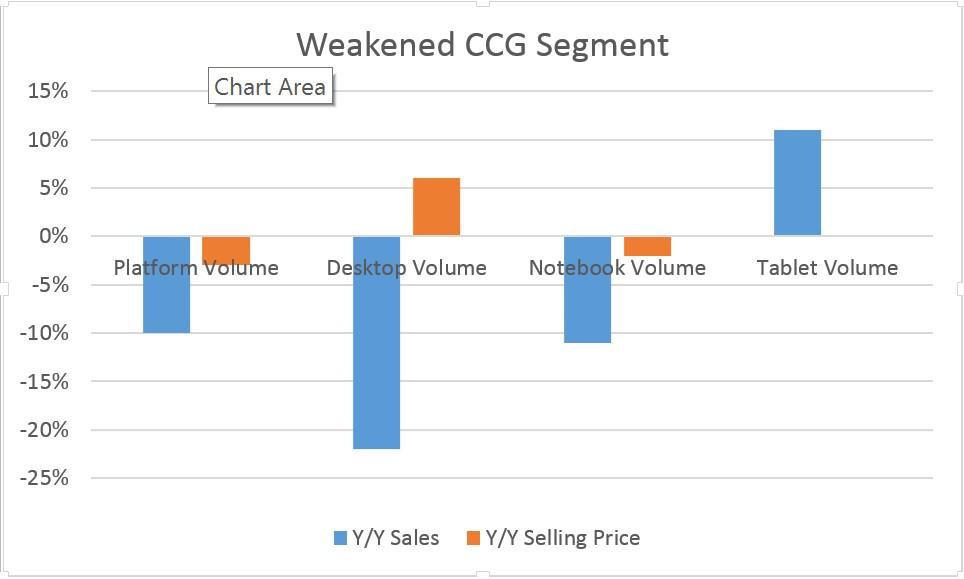
Intel's Client Computing Group $7.5 billion in sales pale in comparison to last year's Q2, but is actually up 2% sequentially. Virtually every aspect of the business segment was down compared to 2014.
(click to enlarge)
This decline was expected in lieu with PC sales tumbling down. Tablet success is obviously a positive to take away from the performance, but this shouldn't be replicated as the PC market climbs out of its hole. Many tablets still lack the complete functionality that comes with PCs. A gap is still needed to be bridged.
Next, we go on to the company's Server revenue, in the form of the Data Center Group segment. This business segment brought home $3.9 billion for Q2. This is a 5% increase from last quarter, and a 10% increase from Q2 2014. It brought home over $1.8 billion in operating income, the most from any business segment. Intel has stressed the importance of this segment, as it is cheaper to operate than its CCG segment, and delivers strong sales. Unit volumes were up 2% and 5% for Q/Q and Y/Y respectively. In addition, average sales price increased by 3% and 5% for Q/Q and Y/Y performance. Intel is generating more volume and obtaining larger payments for its DCG products.
The Internet of Things Group (dubbed IoTC) also impressed. Revenue for the IoTC segment increased 4% sequentially, and 5% Y/Y. Total revenue for the segment was $559 million.
Lastly, Intel's Software and services segment generated revenue of $534 million, flat sequentially and down 3% Y/Y. Intel's "other" segment produced $715 million, up 38% from 2014. This segment includes flash memory and devices.
Well, there you have the segment breakdown. Now I'll explain the guidance situation, and how Intel is still a great company for shareholders.

Guidance Game and Miscellaneous

No doubt investors were curious about Intel's outlook for both Q3 and the rest of 2015. Intel offered expectations that seem reasonable, and perhaps beatable.
For Q3:
Revenue is expected to be $14.3 billion, which would be over an 8% sequential increase. This means that Intel immediately expects Windows 10 to help bolster revenue significantly. My concern is that if they are wrong and overestimate PC sales in relation to the new software release, analysts and investors alike will come down hard on the company (and rightfully so). Margins are also expected to be stronger in Q3, with a 63% figure currently predicted. Intel is somehow finding ways to cut operating expenses, and they should be commended for it. Intel is already upping the ante with higher R&D expenses than expected, so it's a good sign that they are saving elsewhere. R&D will continue to be around $4.9-$5 billion, especially after other technological breakthroughs are occurring, such as the new capabilities for the 7nm chip that IBM is developing. Whether or not the development of 7nm chips would be a profitable venture at this point is a discussion for another time. The point is that other companies are having breakthrough discoveries, and it is good to know that Intel does not plan on lessening its R&D.
For 2015:
Revenue for the 2015 year is expected to fall about 1% short of last year's number. This shows two things: One is that Intel has come to terms with the fact that they cannot replicate last year's revenue (they finally altered their "flat" revenue expectation). Second is that this number is much lower than the near 2% decline that many analysts were calling for. Margins are expected to come in a 61.5%, a very solid number considering the start-up costs for the production of Intel's 10nm chips. R&D spending for the year is expected to be around $19.8 billion, plus or minus $400 million. As I just explained, R&D spending shows the commitment of Intel's management in discovering a new scientific breakthrough, and I commend them for it.
Speaking of management, let's look at what Intel does for its shareholders. After spending $4 billion on stock buybacks in 2014's Q4, then another $750 million in buybacks in Q1, it was great to see another large buyback totaling $697 million for this quarter. Q2 for Intel ended with $16 billion in cash/investments, so they are poised to continue this for the time-being. Also, they sport a charming current ratio of 1.97, showing that they will easily maintain operations and avoid being hindered by current liabilities. Intel also paid cash dividends totaling $1.1 billion.

Conclusion

Intel's Q2 report largely shocked the investment world, offering figures well above expectations. Skepticism is still properly in the air, as the PC market continues its decline, but Intel has demonstrated its capability to thrive in a nasty environment. With a solid guidance for the rest of the year, and a healthy share buyback and dividend system in place, Intel offers a compelling investment.