Affichage des articles dont le libellé est Computers Technology. Afficher tous les articles

samedi 11 mai 2013

Cy-fi ?


It’s not finance, it’s Cy-fi


Nanex, the market analysts who like to create visual representations of the markets, have animated half a second of trading activity in Johnson & Johnson stock. The results are quite intoxicating to watch:
To us it almost looks like an organic nervous system in action.
Which makes us wonder, is this really as bad a development as HFT’s critics make it out to be?
Cue a research paper just released by Tom Lin of the University of Florida. He argues that it’s no coincidence that “modern finance is becoming an industry in which the main players are no longer entirely human. Instead, the key players are now cyborgs: part machine, part human. Modern finance is transforming into what this Article calls cyborg finance.”
Call it the dawn of Cyborg finance, or “Cy-fi” as he calls it for short.
A few choice extracts from his paper (our emphasis):
In sum, increased reliance on computerization and artificial intelligence in finance has fundamentally transformed modern finance into cyborg finance, an industry that is faster, larger, more global, more interconnected, and less human than its previous iterations.
The transformation of modern finance into cyborg finance has precipitateda conceptual evolution in prevailing legal understandings of financial regulation’s main character: the investor. With the aid of computers, a new aspirational in- vestor paradigm has emerged and holds the potential to be more informed, more diversified, more rational, and faster than previous paradigms. And law must become more cognizant of this emerging, new investor paradigm in order to remain effective.
—-
Fifth, compared to the other models, the new investor is more humble about its capabilities and knowledge. While the new investor possesses more knowledge and investing capabilities relative to its predecessors, the new investor is also more mindful of its limitations, the limitations of models, and the limitations of technology. The new investor is more aware of the role of randomness, serendipity, and uncertainty in life and finance. The new investor has a vast library of data and information but also has a vast antilibrary: a collection of known unknowns and unknown unknowns; a repository of unlearned knowledge. The antilibrary tempers the new investor’s confidence in its capabilities and knowledge as it relates to financial markets.
We do wonder what Nassim Taleb would make of the anti-library concept and its effects on risk…
Though as Lin puts it, it’s really about the perils of being “too linked to fail”:
Modern finance exists as an expansive, interconnected network that crosses institutions, industries, states, and products—creating a systemic problem that this Article terms “too linked to fail.” In the age of cy-fi, commercial banks, investment banks, hedge funds, mutual funds, pension funds, private equity firms, nation-states, wealthy traders, and a host of other players and institutions are all bounded together as part of this growing financial web of mutuality. And within the mesh of that financial web are financial products that have also grown more linked to one another.
Another thoughtful point from the paper: Cyborg finance means there are, in some ways, no borders anymore:
Whereas in eras past the failure of one financial institution, one sovereign treasury, or one financial product was largely and better contained by geography, cyborg finance has obliterated all borders and boundaries. The financial problems of one nation-state can now affect all nation-states like never before.
But, as Lin’s conclusion hints, perhaps it’s just the next phase in Darwinian evolution anyway?
The telos of technology is not to render us useless but to aid us in our progress andevolution. This is the very nature and “perfection of man.”Just as the spear, the wheel, and the printing press aided our predecessors in the past, the computer, its memory, its speed, and its programs will aid us in the future. And so we must build new constructs—legal, financial, and others—to harness the potential of this transformative technology while taming its hostilities. In the end, this is the challenge, the promise, and the hope of the new investor.
Certainly the stuff of memetics and temes, with some interesting consequences for game theory (as well as evolutionary game theory).

mercredi 6 mars 2013

High-Yield Stock ?


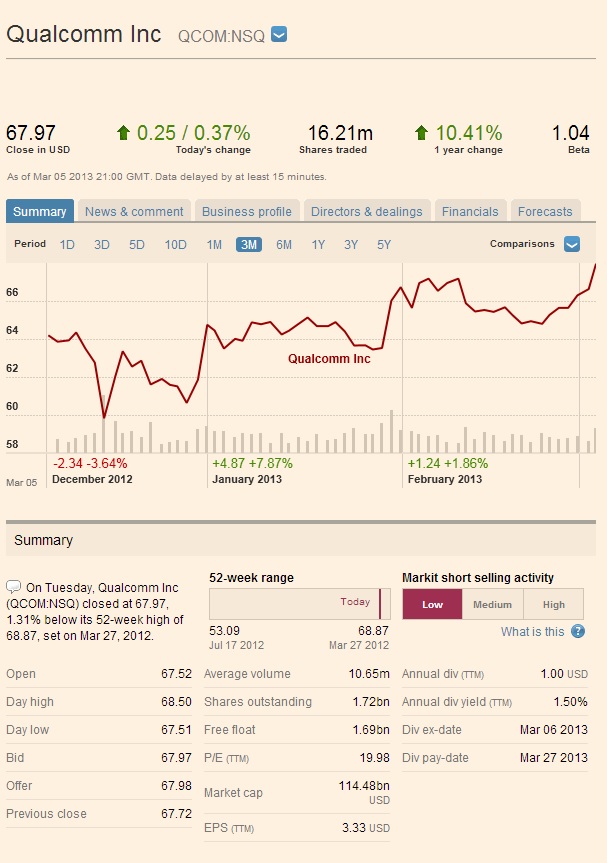
QUALCOMM INC COM USD0.0001 (QCOM)

67,97 USD 
+2,01% | +1,34 
 05/03/2013 22:00


(AOF) - Qualcomm progresse de 2,01% à 67,97 dollars, bénéficiant de sa générosité avec ses actionnaires. Le fabricant de puces pour les smartphones a annoncé une hausse de 40% de son dividende et un nouveau programme de rachat d'actions de 5 milliards de dollars. Le groupe versera désormais un dividende de 35 cents par action, contre 25 cents auparavant. Cette hausse sera effective à partir du dividende trimestriel payable après le 27 mars. Le nouveau programme de rachat d'actions remplace l'ancien programme de 4 milliards de dollars, dont il restait 2,5 milliards de dollars à utiliser.

« Notre business model continue de générer un important cash flow opérationnel qui nous permet d'investir et de mettre en place nos priorités stratégiques, tout en restituant du capital à nos actionnaires. Depuis le début de ces programmes en 2003, nous avons distribué 19,9 milliards de dollars à nos actionnaires via des rachats d'actions et des dividendes », a expliqué le P-DG Paul E. Jacobs.

Au premier trimestre, clos fin décembre, le concurrent de STMicroelectronics a réalisé un bénéfice net en progression de 36% à 1,91 milliard de dollars, soit 1,09 dollar par action. Le chiffre d'affaires a, lui, augmenté de 29% à 6,02 milliards de dollars. 

Le groupe, qui fabrique des puces pour téléphone portable et détient de nombreux brevets très rentables sur la téléphonie 3G et le LTE, surfe sur le boom des smartphones et des tablettes. Son dynamisme fait pâlir d'envie nombre de ses concurrents.

Qualcomm est le troisième fabricant mondial de semi-conducteurs derrière Intel et Samsung, selon le bureau d'études Gartner. Il est le seul groupe de ce trio à avoir enregistré une progression de son activité en 2012.

AOF - EN SAVOIR PLUS 

LE SECTEUR DE LA VALEUR 

Equipementiers télécoms 

Certains analystes estiment qu'en dépit d'une hausse de 7% des investissements des grands opérateurs, le marché des équipements mobiles devrait baisser de 6% cette année et stagner en 2013. La bataille que se livrent les équipementiers pour se positionner sur la 4G (« Long Term Evolution » ou LTE) s'effectue au détriment de leurs marges. Les acteurs se concentrent sur les métiers les plus rentables et réorganisent leurs activités pour maintenir leur rentabilité. Ainsi Alcatel-Lucent, qui ne cesse de se réorganiser, a récemment présenté son deuxième plan de restructuration en trois ans. Nokia Siemens Networks, qui a supprimé le quart de ses effectifs à travers le monde, a choisi de se focaliser sur les équipements de réseaux pour la téléphonie mobile.

Copyright 2013 Agence Option Finance (AOF) - Tous droits de reproduction réservés par AOF. AOF collecte ses données auprès des sources qu'elle considère les plus sûres. Toutefois, le lecteur reste seul responsable de leur interprétation et de l'utilisation des informations mises à sa disposition. Ainsi le lecteur devra tenir AOF et ses contributeurs indemnes de toute réclamation résultant de cette utilisation. Agence Option Finance (AOF) est une marque du groupe Option Finance


Source:AOF 05.03.2013 17:22


vendredi 11 janvier 2013

Cirrus @ The Fool


CIRRUS LOGIC INC COM USD0.001 (CRUS)

31,54 USD 
+4,40% | +1,33 
 10/01/2013 22:00


COMPANY RESULTS: Cirrus Logic Inc. (NASDAQ: US:CRUS)

After Hours
4:42 p.m.
$
31.21
Change
-0.33 -1.04%
Volume
40,829
Real time quotes
Day low
Day high
$30.71
$31.97
52 week low
52 week high
$19.10
$45.49
32.00
31.50
31.00
30.50
30.00
10a
12p
2p
4p


Market cap
$1.98B
Average volume
3.67M
P/E ratio
19.59
Rev. per Employee
$777,780
EPS
1.61
Dividend
N/A
Div yield
N/A
Ex dividend date
N/A


Company Description 

Cirrus Logic, Inc. develops high-precision, analog and mixed-signal integrated circuits for audio and energy markets. It delivers optimized products for consumer and commercial audio, automotive entertainment, and targeted industrial and energy-related applications. It also develops ICs, board-level modules and hybrids for high-power amplifier applications branded as the Apex Precision Power line of products. The company product lines include: Audio & Energy. The Audio product line develops high-precision analog and mixed-signal components, as well as audio digital signal processor products for consumer, professional and automotive entertainment markets. The Energy product line develops high-precision analog and mixed-signal components for energy-related applications, such as energy measurement, energy exploration and energy control systems. It also includes ICs, board-level modules and hybrids for high-power pulse width modulation and power amplifier applications. Cirrus Logic was founded by Suhas S. Patil and Michael L. Hackworth in 1984 and is headquartered in Austin, TX.


More Cirrus Logic, too ...
I won't spend as long discussing my second buy, in part because it's an Apple derivative play. I'll be picking up a bit more Cirrus Logic (NASDAQ: CRUS  ) .
The company definitely comes with its risks, as a whopping 79% of its revenues came from Apple last quarter, but it's also been expanding its role in Apple's products.
Simply put, it's a company that's sold off quite a bit recently, and the sell-off has been baffling to me. In the December quarter, Cirrus guided to sales that would be up about 145% year over year on the high end of its guidance. The reason is simple, Cirrus Logic made major gains in the amount -- and value -- of its chips going into the new iPhone 5. Those eye-popping rates will come back to Earth later next year, but by the time they do, the company will be trading at single-digit earnings multiples.
Why's Cirrus selling off in spite of such great news with Apple? Well, the company guided to margins that could be decreasing 2 to 3 percentage points concurrent with its massive rise in revenues. This seems like an overblown concern to me. I'll quote Cirrus Logic CEO Jason Rhode on his reaction to the situation:
"Achieving approximately double the revenue with only a few points of margin erosion is a trade-off most semiconductor companies would happily make in light of the huge growth in operating profit that this drives."
That about sums up my reaction as well. In any case, I'll be adding 20 more shares of Cirrus to my portfolio tomorrow. That's a smaller buy than Apple, but it's also a smaller and riskier company.


Directors & officers

 NameTitleCompensationAgeOfficer
since
 
AlanSchuele
Chairman of the Board
--
66
2012
Mr. Alan R. Schuele has been appointed as Chairman of the Board of Cirrus Logic, Inc., effective August 01, 2012. Mr. Schuele was first elected to Cirrus Logic's Board of Directors in July 2011. Schuele has been a general partner since 2000 with Sevin Rosen Funds, a high tech venture capital firm, and is currently a director of Javelin Semiconductor. Prior to Sevin Rosen, he was chief executive officer of Benchmarq Microelectronics and served as president, chief operating officer and a director of the Board of Unitrode Corp. after its merger with Benchmarq. Other past semiconductor company experience includes various sales, marketing, and executive positions at Cirrus Logic, Crystal Semiconductor, Cypress Semiconductor, Mostek, Motorola and Texas Instruments.
 
JasonRhode
President, Chief Executive Officer, Director
454.72k USD
42
2004
 
ThurmanCase
Chief Financial Officer, Vice President, Principal Accounting Officer
263.94k USD
55
2002
 
ScottAnderson
Senior Vice President, General Manager - Mixed-Signal Audio Products
279.29k USD
58
2007
 
GregoryThomas
Vice President, General Counsel, Corporate Secretary
295.50k USD
46
2003
 
GregoryBrennan
Vice President, General Manager - Apex Precision Power
--
50
2008
 
ThomasStein
Vice President and General Manager - EXL Products
237.01k USD
40
2008
 
TimothyTurk
Vice President - Worldwide Sales
--
55
2007
 
Jo- DeeBenson
Vice President - Corporate Marketing Communications and Human Resources
--
52
2000
 
RandyCarlson
Vice President - Supply Chain Management
--
46
2010
 
JohnCarter
Independent Director
--
57
2009
 
TimothyDehne
Independent Director
--
46
2009
 
WilliamSherman
Independent Director
--
69
2001
 
SusanWang
Independent Director
--
61
2011
Officers and Directors data as of Jan 06 2013